



FOCUS
15.05.2026
Agentic AI and Digital sovereignty: solving the Telco paradox
How intelligent autonomy is reshaping telecom operations amid exploding traffic demand and stagnant revenues — while ensuring control, efficiency, and digital sovereignty
The Telco paradox: more traffic, lower margins
The telecommunications industry is undergoing a profound transformation. On one side, fixed and mobile networks are experiencing exponential growth in data traffic. On the other, telecom operators are facing increasing pressure on profitability. The result is a true industry paradox: the need to invest in ever more complex infrastructures while revenues remain flat and operational costs continue to rise.
In this scenario, the growing complexity of modern networks — spanning legacy systems, cloud-native architectures, and edge computing environments — makes traditional static automation approaches unsustainable. This is where Italtel positions its value proposition, aiming to fundamentally redefine telecom operating models through Agentic AI.
Agentic AI as the foundation for Autonomous Networks
Autonomous Networks have long been a strategic objective for the telecom industry and for international standardization bodies. Today, however, the technological conditions finally exist to make them operational at scale.
Agentic AI introduces a new paradigm in which AI agents do not simply support decision-making processes; they can interpret intents and translate them into operational actions across the network. This enables intent-based operational models, where operators define high-level business objectives and the system autonomously executes the required actions.

“
“With Agentic AI, we move from passive model utilization to an active and proactive approach: agents no longer just provide recommendations, but directly interact with systems, enabling a new level of intelligent automation.”
explains Giorgio Angiolini, Technology Advisory at Italtel
A three-layer architecture for Intelligent Autonomy
Italtel’s value proposition is built around a multi-layer architecture designed to balance operational autonomy with governance and control.
The first layer consists of super agents, powered by advanced Large Language Models (LLMs), responsible for orchestration and coordination activities.
The second layer includes domain expert agents — localized AI agents specialized in specific network domains. These agents operate close to operator-owned data, ensuring high accuracy, low latency, and real-time performance.
The third layer is the communication fabric, which includes the network infrastructure and field systems where agents execute operational actions.
Interaction among these layers is enabled by open and standardized protocols that allow distributed cooperation between agents. This architecture supports the creation of a scalable, flexible, and interoperable ecosystem.
Digital sovereignty and a European AI approach
One of the defining aspects of Italtel’s strategy is its strong focus on digital sovereignty.
In a market increasingly dominated by global hyperscalers, concerns are growing around the management of mission-critical data and the control of strategic information within telecom infrastructures. This issue becomes even more critical in agentic architectures, where organizations are no longer sharing only data, but also operational behaviors, policies, and automated actions executed on the network.
In this context, sovereignty extends beyond data localization. It also involves maintaining control over the decision-making logic of AI agents themselves. Ensuring that policies, governance rules, and security mechanisms remain under operator control becomes an essential architectural requirement for scalable and secure Agentic AI adoption.
Italtel addresses this challenge through a model in which local agents operate close to the data at the edge, minimizing the need to transfer sensitive information to external platforms. This approach combines the benefits of advanced LLMs with compliance requirements aligned with European regulations, including the European Union AI Act.
“
“We cannot give up the power of Large Language Models, but we must ensure that critical data remains under operators’ control. Our architecture was designed precisely to balance innovation and sovereignty.”
as Giorgio Angiolini, Technology Advisory at Italtel notes,
Operational efficiency and new cost models
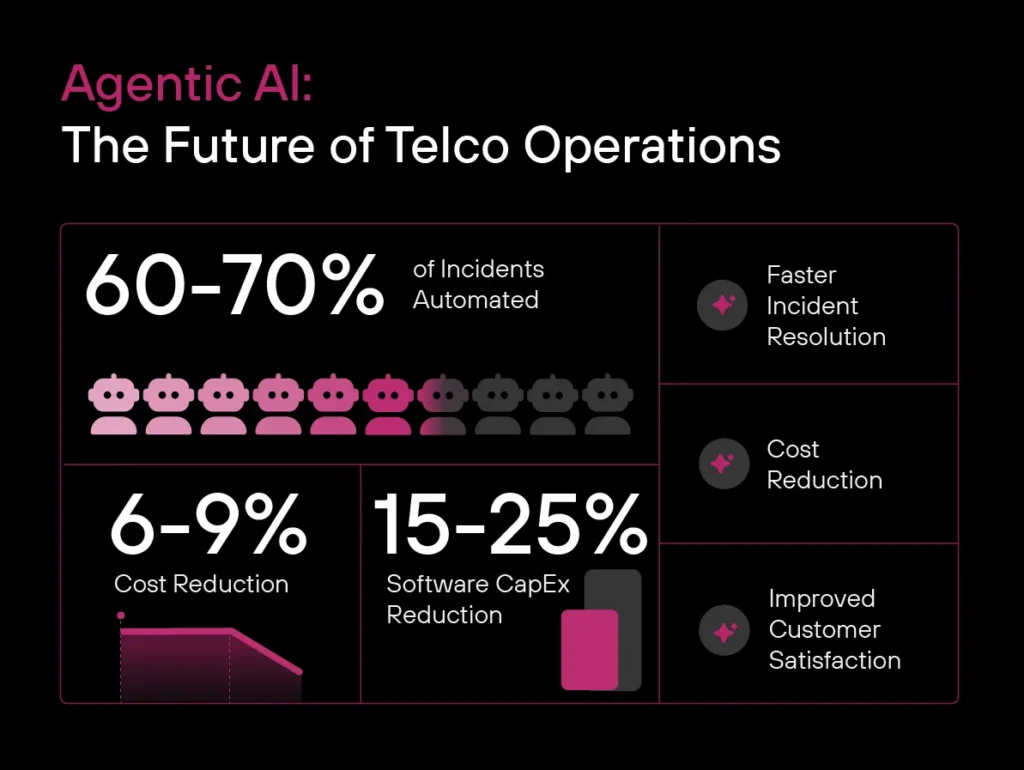
The adoption of Agentic AI delivers tangible benefits across the entire operational value chain. Networks become capable of self-configuration, self-optimization, and self-healing, dramatically reducing manual intervention.
Expected outcomes include shorter repair times, optimized planning activities, and significant reductions in fault management complexity. These improvements translate into structural reductions in both OpEx and CapEx, while also simplifying back-office operations.
More broadly, organizations move from rigid operational models to dynamic infrastructures capable of automatically adapting to changing operational conditions. This also accelerates the introduction of new services and enables faster creation of new revenue streams.
Towards governed and sustainable autonomy
Today, Agentic AI represents a concrete response to many of the structural challenges facing the telecom sector. However, the real value lies not only in the technology itself, but in the ability to integrate it into a scalable, interoperable, and governable operating model.
Italtel’s approach stands out by combining operational autonomy, interoperability, and data sovereignty, providing operators with a practical path to overcome the current telecom paradox.
As explored in the previous article on the evolution from Telco to TechCo, autonomous networks are no longer a future vision — they are already becoming reality.
Ultimately, competitive differentiation will depend on organizations’ ability to keep people at the center of innovation, using technology to generate measurable business value while ensuring efficiency, governance, and compliance with evolving regulations, starting with the European AI Act.
Discover the foundations of Agentic AI in telecom networks
Explore how AI Agents are enabling autonomous operations and transforming the evolution from Telco to TechCo: AI Agents: What They Are and Why They Are Transforming Telecommunications
TECH KEYWORDS
ARTIFICIAL INTELLIGENCE
NETWORKS AS A SERVICE
AGENTIC AI
AUTONOMOUS NETWORKS
TELCO AUTOMATION
SHARE THE PAGE