



INTERVIEW
26.06.2026
Integrated Compliance: from Regulatory Obligation to Strategic Business Enabler
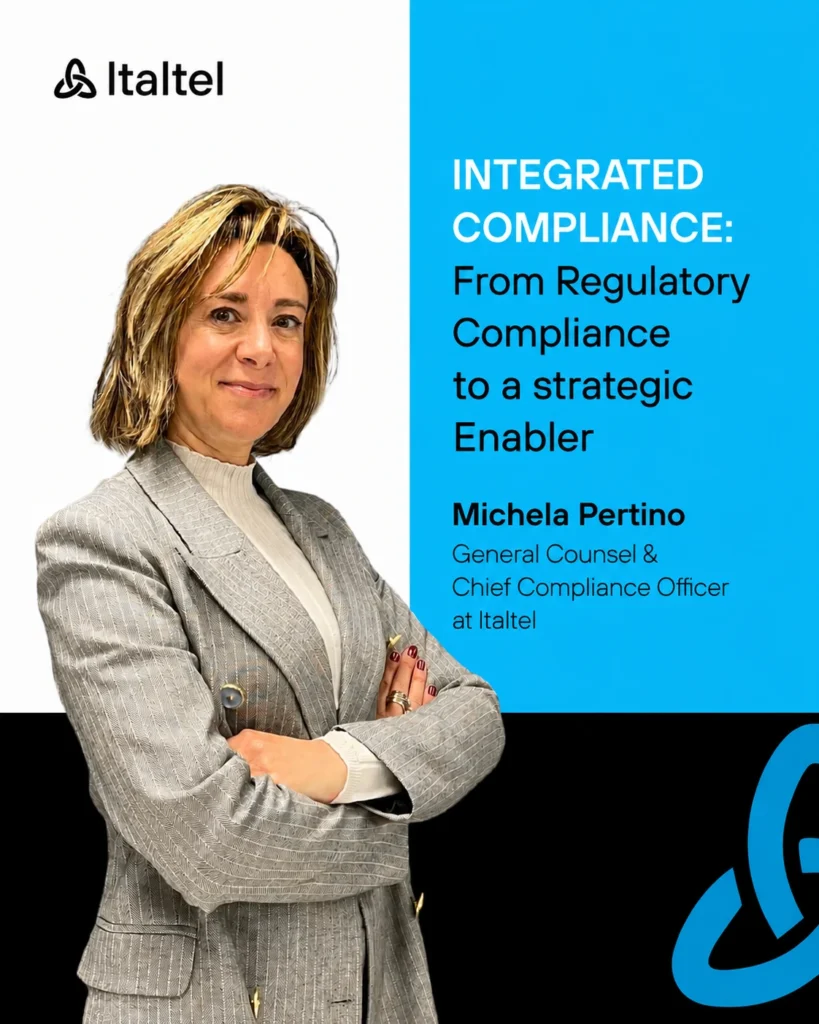
An interview with Michela Pertino, General Counsel & Chief Compliance Officer at Italtel, on the strategic value of integrated risk and compliance management.
As regulatory requirements continue to grow in complexity, organizations are increasingly required to manage interconnected obligations spanning privacy, cybersecurity, corporate governance, contractual requirements, and regulatory compliance. In this evolving landscape, compliance can no longer be treated as a collection of isolated obligations. Instead, it requires an integrated approach that aligns risk management, control processes, and business objectives.
We spoke with Michela Pertino, General Counsel & Chief Compliance Officer at Italtel, to explore the value of integrated compliance and understand how it can become not only a safeguard for organizations and their customers, but also a driver of competitiveness and sustainable growth.
Michela, integrated compliance has become a widely discussed topic. What does it actually mean for a business?
To answer this question, it is important to recognize that the regulatory landscape has become significantly more complex over the past few years. Compliance requirements now affect virtually every business process and every aspect of corporate operations. As a result, the compliance function has become a central pillar of corporate governance, while also becoming increasingly challenging to manage.
Integrated compliance enables organizations to manage regulatory obligations in a coordinated and cross-functional manner. Rather than simply ensuring compliance with individual regulations, it provides a framework that creates synergies across different disciplines and business functions, improving overall organizational efficiency.
Today, companies must simultaneously comply with multiple regulations—including data protection, cybersecurity, corporate liability frameworks, and industry-specific requirements—which often overlap. Managing these obligations independently can lead to inefficiencies and duplication. An integrated approach, by contrast, provides a unified view of risk and enables consistent, coordinated governance processes.
Why are privacy, cybersecurity, contractual requirements, and regulatory obligations becoming increasingly interconnected?
Digital transformation has fundamentally changed the way organizations operate, making these domains closely interdependent.
Today:
- contractual obligations often require specific cybersecurity controls;
- a cyber incident may have significant implications for personal data protection;
- regulatory requirements frequently impact multiple business processes simultaneously.
As a result, the same business processes, data assets, and technologies are subject to multiple compliance requirements at the same time.
This is why a silo-based approach to compliance is no longer sustainable.
For Italtel, as a provider of digital services, is this even more critical?
Absolutely.
For digital service providers, compliance is no longer just an internal governance issue—it is an essential component of the value delivered to customers.
Organizations providing cloud services, software solutions, and digital platforms must demonstrate that they operate according to the highest standards of:
- data security;
- system reliability;
- business continuity;
- contractual and regulatory compliance.
From this perspective, investing in an integrated compliance framework becomes a competitive advantage. It strengthens customer trust and enables organizations to respond more effectively to the expectations of clients, partners, and stakeholders.
What are the main benefits of adopting an integrated compliance approach?
An integrated compliance framework creates tangible business value by delivering several key benefits:
- Reduced risk, through a unified risk management approach and faster response capabilities.
- Greater operational efficiency, by eliminating overlaps and duplication across different functions while optimizing processes and resources.
- Stronger governance, with improved transparency, oversight, and reporting capabilities.
- Strategic business support, strengthening relationships with customers and stakeholders, enhancing corporate credibility, and protecting the organization’s reputation.
In other words, compliance becomes a true business partner. It makes organizations more resilient, trustworthy, and sustainable, while creating competitive advantages that support long-term growth.
Ultimately, when properly designed, compliance is much more than regulatory adherence—it is a modern way of doing business. It enables organizations to operate more efficiently, innovate with confidence, and compete more effectively.
For Italtel, investing in an increasingly integrated compliance framework is therefore a strategic decision: a distinctive capability that generates long-term value while strengthening market confidence.
TECH KEYWORDS
INTEGRATED COMPLIANCE
GOVERNANCE, RISK & COMPLIANCE (GRC)
CYBER RESILIENCE
DATA PROTECTION
SECURE DIGITAL SERVICES
SHARE THE NEWS